What Is TMJ Arthroscopy and When Is It Needed?
Home
What Is TMJ Arthroscopy and When Is It Needed?

Home
What Is TMJ Arthroscopy and When Is It Needed?
Jaw pain has a way of making the small stuff hard, eating, talking, yawning, even opening your mouth. When medicines, exercises, or other non-surgical approaches aren't cutting it, your dentist or TMJ specialist might suggest a closer look at the joint itself. TMJ arthroscopy is one way to do that.
Trying to figure out TMJ Arthroscopy treatment in Ahmedabad? It helps to know a few things going in, what actually happens during the procedure, why a doctor would recommend it, and roughly what you're in for afterward. HealMe Pain Clinic evaluates each case individually, so the guidance you get lines up with what's actually causing your TMJ problem, not a one-size-fits-all answer.
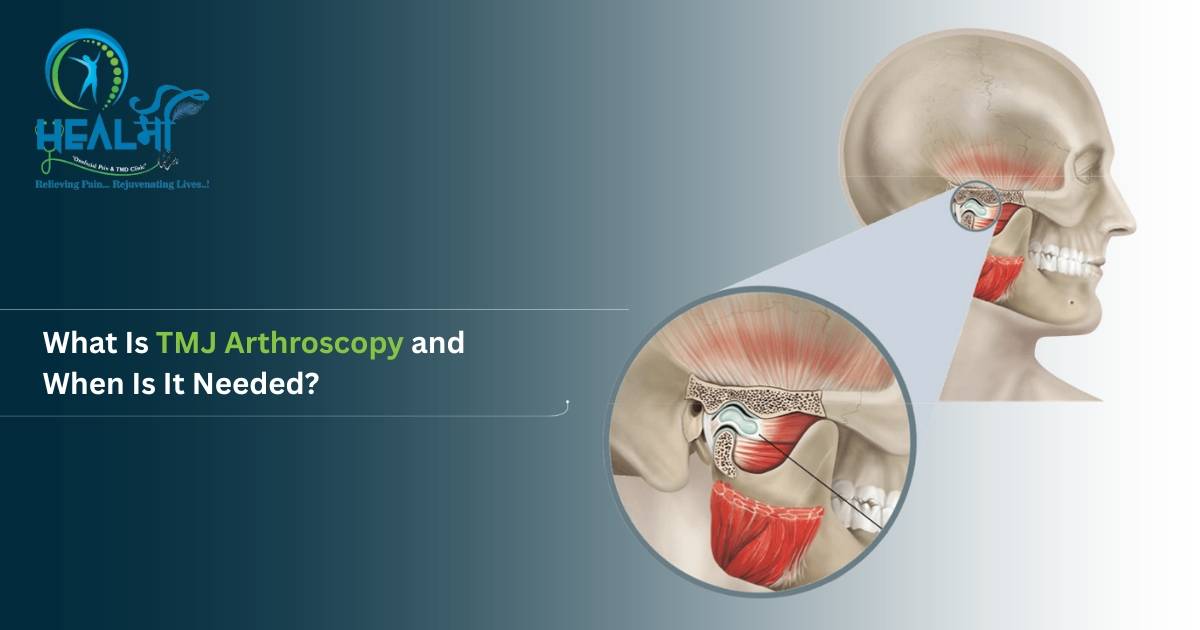
Think keyhole surgery, but for the jaw joint. Rather than cutting the joint fully open, a specialist works through a tiny opening near it, guiding in a thin camera, an arthroscope, to see exactly what's happening inside. If something needs fixing, small instruments go in through that same opening.
That's the main advantage over open jaw surgery: smaller incisions, and the surrounding tissue stays largely undisturbed.
There's rarely just one cause. Inflammation inside the joint is common, and so is the disc shifting out of position. Arthritis can affect the TMJ like it affects other joints. A jaw injury, ongoing teeth grinding or clenching, and the gradual internal changes that come with a long-standing TMJ disorder can all play a part, as can limited jaw movement generally.
Symptoms vary from person to person. Some mainly deal with pain, while others notice clicking, locking, stiffness, or trouble opening their mouth fully.
Not everyone with TMJ pain needs arthroscopy, doctors generally reach for it once symptoms stick around despite proper non-surgical treatment.
It tends to come up as an option when jaw pain interferes with daily life, when the jaw keeps locking or getting stuck, or when mouth opening stays significantly limited. Inflammation inside the joint, a disc that isn't moving right, or conservative treatment simply not delivering enough relief are all reasons a specialist might recommend it. Sometimes the joint just needs direct examination to know what's really going on.
Getting an accurate diagnosis matters before any of that gets decided. A specialist will typically look at your symptoms, jaw movement, bite, medical history, and imaging results before recommending arthroscopy.
You'll be under anesthesia for this, local or general, whichever fits your case and what the specialist has planned.
A small opening near the TMJ lets the arthroscope into the joint, giving the specialist a direct view, often revealing things symptoms alone wouldn't fully explain.
From there, treatment depends on what's found, washing out the joint, clearing inflammatory material, releasing adhesions, or addressing specific internal problems. Since TMJ disorders differ so much between patients, the exact steps aren't the same for everyone.
Recovery comes down to what was treated and how the patient is doing overall.
Mild swelling, soreness, or temporary jaw stiffness aren't unusual afterward. Your doctor may recommend jaw exercises, a soft diet for a while, pain control, and other aftercare steps, worth actually following, since controlled jaw movement plays a real role in healing.
Your specialist will let you know when it's safe to return to normal eating, exercise, and everyday activities.
Depends entirely on the problem.
Arthroscopy is less invasive and works well for certain joint conditions, but it's not right for every TMJ disorder. Some more advanced structural problems call for a different approach.
The goal isn't to automatically pick the least invasive option. It's matching treatment to what's actually causing the symptoms.
If jaw pain has lasted weeks, keeps coming back, or gets in the way of eating and speaking, it's worth getting checked rather than pushing through it.
An early assessment helps figure out whether conservative treatment will be enough, or whether something like arthroscopy is worth considering.
If TMJ Arthroscopy treatment in Ahmedabad is something you're exploring, HealMe Pain Clinic can help you understand your condition and options before you decide anything.
Constant jaw pain, clicking, or locking isn't something you have to live with. A proper TMJ evaluation can pin down the source of the problem and point you toward the right treatment.
At HealMe Pain Clinic, the focus stays on understanding what's actually going on with each patient and choosing treatment to match. If conservative care isn't enough, TMJ arthroscopy may be worth discussing with a specialist as a next step. Call 87806 77703 today and strat your journey towards healthy live.
The procedure itself happens under anesthesia, so you won't feel it as it's being done. Some soreness or swelling can show up during recovery.
That depends on what's being treated and the specific approach your specialist plans for your case.
It can help selected patients whose locking comes from an internal joint problem, but the underlying cause needs to be identified first.
No. A lot of TMJ problems respond well to non-surgical treatment. Arthroscopy only comes into the picture when it actually fits the patient's condition.
If you're searching for TMJ Arthroscopy treatment in Ahmedabad, visit HealMe Pain Clinic, you get qualified TMJ specialist who'll examine your symptoms properly and recommend the right treatment, not just default to a procedure based on symptoms alone.